
Structural Calm
How leaders create the conditions for clear judgment when pressure rises

Most organizations do not lose their way because people lack talent, effort, or commitment. They lose their way because pressure changes the environment faster than the organization changes its way of thinking. The room gets louder. The calendar fills. Updates multiply. Leaders ask for answers before the problem has been properly named. Teams begin to optimize for responsiveness rather than understanding. Before long, activity starts to feel like progress, confidence starts to feel like clarity, and urgency starts to crowd out judgment.
That is the environment where certainty theater becomes attractive. When people are anxious, a confident answer can feel like leadership, even when the confidence is running ahead of the facts. A forceful decision can calm the room for a moment, even if the underlying diagnosis is weak. A leader can sound decisive while quietly skipping the harder work of orientation, tradeoff recognition, and disciplined learning. The performance works because it gives people relief. The problem is that relief is not the same thing as resolution.
The answer to certainty theater is not hesitation. It is structural calm.
Structural calm is not a mood, a personality trait, or a preference for quiet rooms. It is a leadership discipline: the deliberate creation of conditions that allow people to think clearly, make responsible decisions, and act with steadiness when pressure would otherwise distort judgment. A naturally calm person can still create organizational chaos. An anxious leader can still create structural calm if they know how to clarify the work, regulate the pressure, and keep the system oriented.
Most approaches treat calm as a mental posture. But under real pressure, the body reacts before the mind decides. Reaction patterns are not character flaws. They are conditioned responses built through experience, and they fire faster than deliberate thought. A leader who has only cognitive tools for staying steady has fewer resources than they think. The capacity to remain physically organized under pressure is trained, not wished into being. That training is physical, not just conceptual.
This matters because organizations often inherit the nervous system of their leaders. When leaders cannot metabolize pressure, they transmit it. Structural calm gives that pressure somewhere better to go.
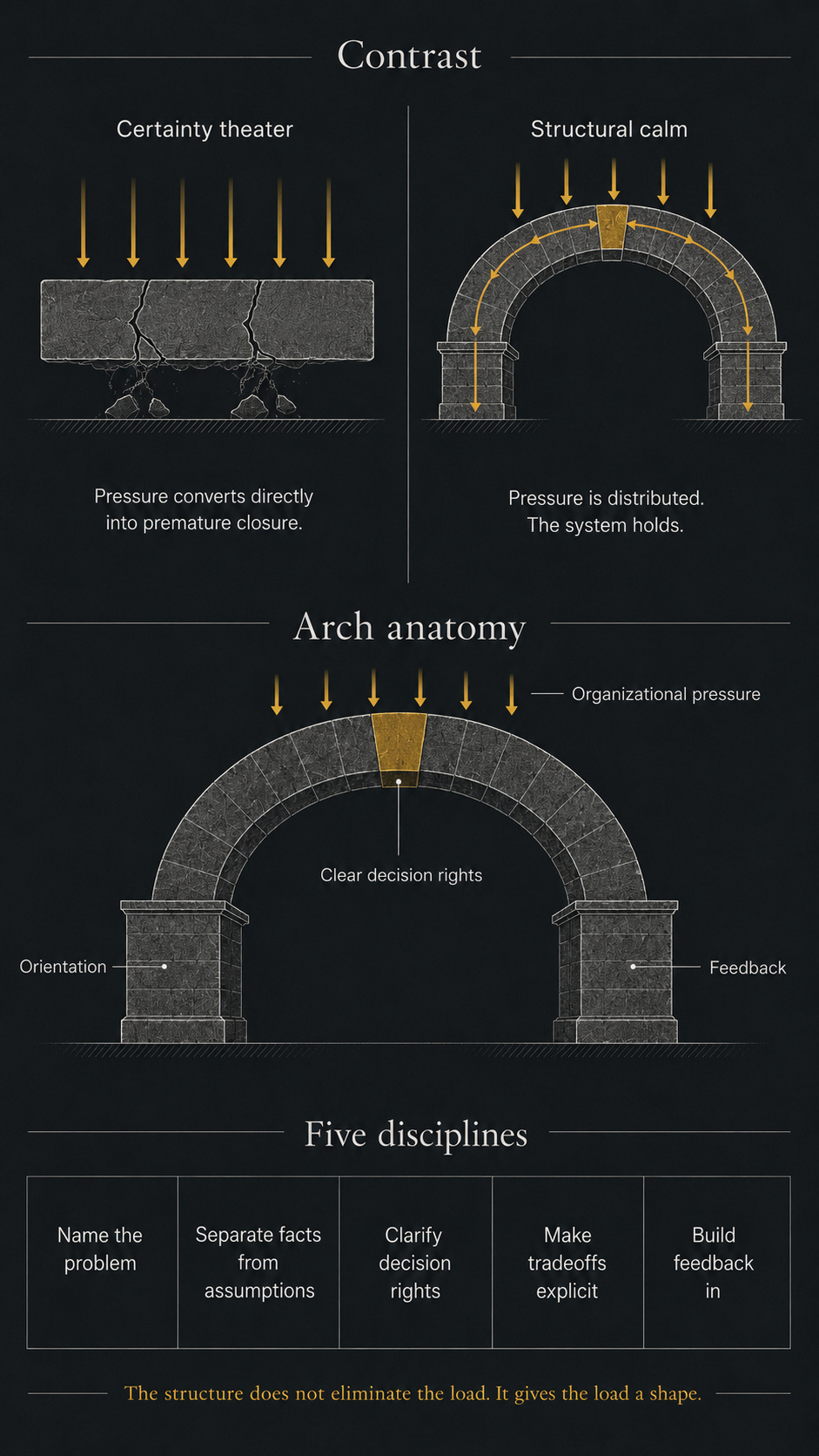
A good arch does not eliminate weight. It gives weight a path. The load pressing down at the crown is carried outward through the stones and into the abutments. Structural calm works the same way. It does not pretend pressure is absent. It distributes pressure through clear decision rights, shared orientation, visible tradeoffs, and feedback loops strong enough to keep the system honest.
Pressure changes how people interpret reality
Pressure does not simply reveal an organization’s culture. It actively changes how people perceive, decide, and communicate. Under pressure, people shorten the distance between signal and reaction. They reach for familiar categories, even when the situation may not fit them. They give extra weight to the loudest concern, the most senior voice, or the most recent data point. They start asking, “What are we doing about this?” before they have spent enough time asking, “What is this?”
When the organization is anxious, people want containment. They want a plan, a message, a metric, a date, a dashboard, a decision, or an accountable owner. Those things may all be necessary, but they can also become substitutes for understanding.
This is one of the quiet ways bad strategy begins. Not from incompetence. Often from premature closure. A complex situation gets simplified too quickly. A partial signal becomes a story. A story becomes a plan. A plan becomes a commitment. By the time the commitment starts to fail, the original uncertainty has disappeared from view. The organization is no longer managing reality. It is managing the consequences of a story it accepted too early.
Structural calm interrupts that pattern. It does not remove urgency, but it gives urgency a shape. It helps the organization distinguish between what must be acted on now, what must be understood better, and what must not be allowed to become noise.
Calm is built into the system
Structural calm is not slow leadership. It is disciplined leadership. It protects the quality of action by improving the quality of interpretation before commitment hardens.
The most useful thing about structural calm is that it does not depend on everyone feeling calm. Leaders and teams can feel anxiety, frustration, or uncertainty and still operate with discipline. The point is not to manufacture emotional serenity. The point is to build a system that can process reality well even when emotions are running high.
That system is built through ordinary leadership practices. It is built when leaders clarify what is known, what is assumed, and what remains uncertain. It is built when decision rights are visible instead of implied. It is built when feedback is treated as evidence rather than as disloyalty. It is built when leaders resist the temptation to collapse a complex situation into a simple story just because the room wants relief.
There is also a communication discipline to structural calm. The leader does not need to hide uncertainty to steady the room. In fact, hiding uncertainty often makes things worse, because people can sense when the official message is cleaner than the actual situation. A better leadership voice is honest without being destabilizing: “We do not know enough yet to make the full decision, but we know enough to take the next step. Here is what we are testing. Here is what we are watching. Here is when we will decide.” That is not indecision. That is responsible movement under uncertainty.
Useful pressure and chaotic pressure
One of the most important functions of leadership is pressure regulation. Not making people comfortable or protecting them from reality, but knowing the difference between pressure that focuses and pressure that scatters.
Useful pressure clarifies what matters. It creates movement toward a meaningful outcome. Chaotic pressure inflates everything, turns every issue into an emergency, and rewards the appearance of urgency over the quality of thought. In chaotic pressure, people spend too much energy proving that they are responsive and not enough energy understanding what the situation requires.
Leaders regulate pressure by shaping what gets amplified. They decide whether the organization treats ambiguity as something to understand or something to cover up. They decide whether dissent is treated as resistance or as data. They decide whether the room is allowed to ask better questions before the plan hardens. These choices may not look dramatic, but they determine whether pressure becomes a force for focus or a source of distortion.
The practical disciplines of structural calm
Structural calm becomes real through a handful of disciplines. These are not complicated, but they require consistency. The arch metaphor holds here too. These are the stones.
- Name the problem before selling the solution. Many organizations fall in love with solutions because solutions create momentum. Diagnosis creates responsibility. It forces the organization to confront what it has misunderstood, avoided, or oversimplified.
- Separate facts, assumptions, interpretations, and preferences. These categories are constantly blended together. When they are not separated, uncertainty gets hidden inside plans and returns later as surprise.
- Clarify decision rights. Ambiguity about who decides is one of the fastest ways to create unnecessary stress. Teams can handle hard decisions. They struggle with invisible authority, shifting approvals, and stakeholder vetoes disguised as feedback.
- Make tradeoffs explicit. If everything is a priority, the real priority becomes whatever carries the most political pressure. Structural calm requires leaders to say what matters most in this situation and what cannot be optimized at the same time.
- Build feedback into the operating rhythm. Feedback is not a postmortem luxury. It is infrastructure. If the organization cannot detect whether its interpretation is wrong, it will keep mistaking activity for progress.
These disciplines matter because structural calm is not created by one inspiring message. It is created by repeated behaviors that teach the organization how to think under pressure. Over time, people learn that clarity is expected, assumptions should be visible, and bad news should travel early enough to matter. That is when calm becomes more than a leader’s tone. It becomes part of the operating system.
The better question
When pressure rises, the instinct is usually to ask, “What do we need to do?” That question matters, but it is rarely sufficient. A better first question is: what structure does this situation require so that we can think clearly enough to act well?
Sometimes the answer will be a decision. Sometimes it will be a pause. Sometimes it will be a smaller test, a clearer owner, a better definition of the problem, or a more honest conversation about tradeoffs. The answer will vary because the situation will vary. The discipline is to resist the reflex of treating every tense moment as if it requires the same leadership response.
Structural calm does not promise certainty. It does not remove risk, erase conflict, or make hard problems easy. It does something more useful. It keeps the organization oriented long enough to make better choices under pressure. It gives people a way to move without pretending the future is more knowable than it is.
The next time the room gets tense, listen for the early signs of certainty theater: the forced confidence, the premature story, the quick answer that gives relief before it earns trust. Then ask the question that may matter most: what would help this system think clearly right now?
That is where structural calm begins. Not by lowering the pressure, but by giving the pressure somewhere responsible to go.