
Feedback Integrity as Infrastructure
Whether honest signal can reach the people who decide is a property of the system, not the mood of the room.

Organizations routinely say they want honest feedback. Many operate in ways that honest feedback cannot survive the trip from where it is known to where it is decided. The knowledge exists. Someone on the team can see the project is in trouble, the assumption is wrong, the number is being managed rather than met. The problem is not that the signal is absent. The problem is that the signal cannot travel. It gets softened at each handoff, rounded toward the answer leadership seems to want, until what arrives at the top is a version clean enough to be useless.
This is not primarily a failure of courage, though it is usually described that way. Telling people to be braver with the truth treats a structural problem as a personal one. The more accurate question is whether the organization is built so that honest signal can move at all. That is what feedback integrity means: not a culture of candor, not a feeling in the room, but the structural property of whether what is actually happening can reach the people who act on it, intact and in time to matter. A feedback system has integrity when it preserves the content, uncertainty, dissent, and timing of a signal as that signal moves from observation to decision.
Treating it as infrastructure changes what you do about it. Infrastructure is built, maintained, and load-tested. It either holds under weight or it does not. You do not motivate a bridge into carrying traffic. You engineer it to, and then you check it. Feedback integrity works the same way. It is not summoned by a leader asking for candor in a tense meeting. It is built into how the organization runs, so that it keeps working when people are tired, anxious, junior, or outranked, which is exactly when informal expectations of candor are most likely to fail.
Why safety is necessary and not sufficient
The most familiar framework for this territory is psychological safety, and it remains foundational. People who expect punishment, humiliation, or retaliation for speaking up will often stay quiet. The problem is not the framework. It is the way organizations frequently operationalize it: as a conversational climate rather than an information system. Safety helps people speak. It does not by itself guarantee that what they say will be preserved, routed, weighed, and answered. It is the precondition for signal to enter the system, not the entire structure required to carry that signal to a decision.
You can see the gap in organizations that have worked hard on safety and still get surprised. People feel free to speak. They raise concerns. And the concerns still do not change anything, because there is no structure that requires the signal to be collected, weighed, carried, and answered. Safety determines whether someone is willing to say the thing. Integrity determines whether the thing, once said, survives the journey to where it matters. A team can feel safe and still operate on a clean story, because conversational safety and informational accuracy are different properties. Both matter, but they do different work.
The distinction matters because the two require different work. Safety is built through how people are treated when they speak. Integrity is built through what the system does with what they say. An organization can improve the first and leave the second untouched, which is why so much feedback work produces better-feeling meetings and the same blind spots.
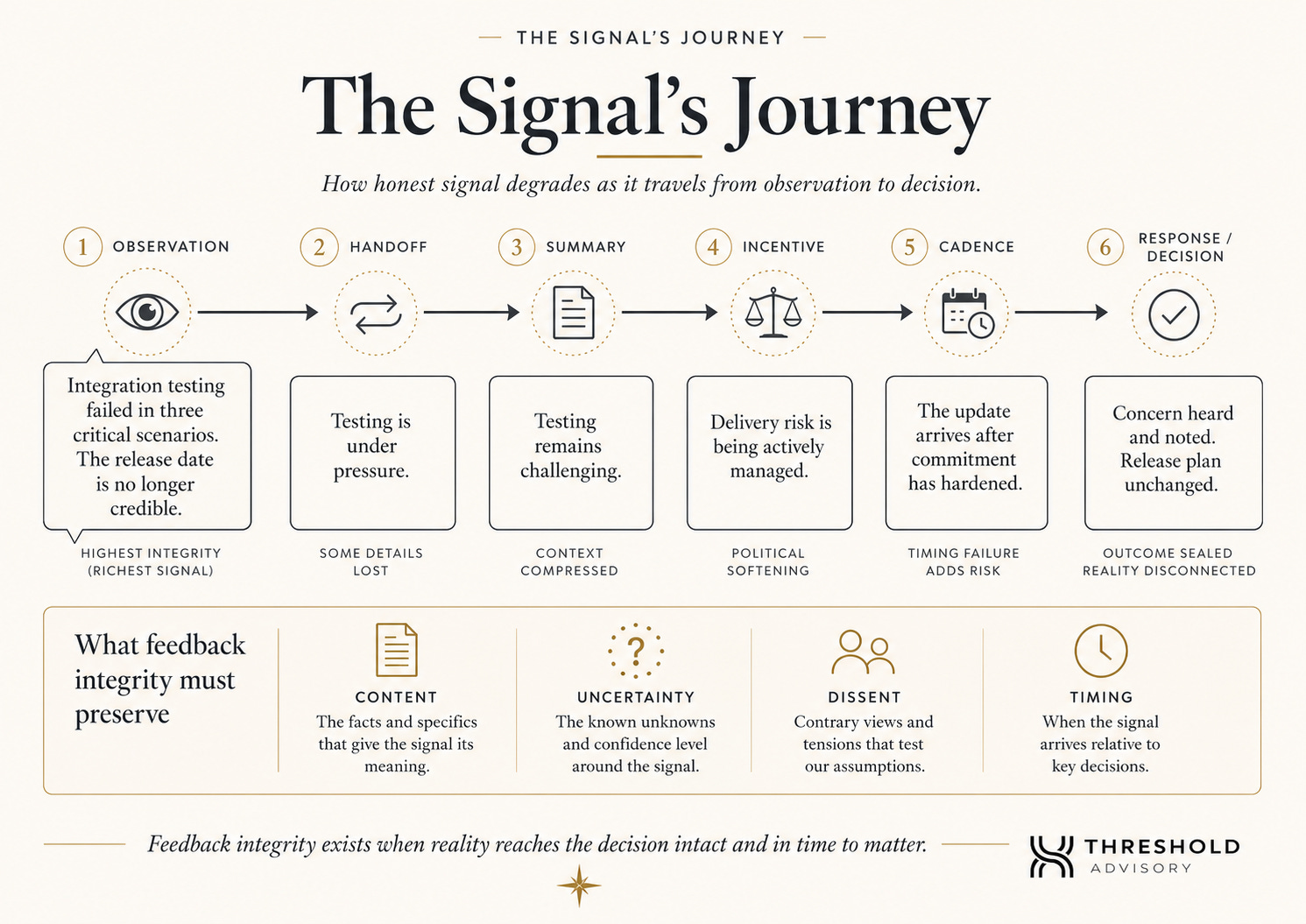
A delivery lead reports that integration testing has failed in three critical scenarios and that the release date is no longer credible. By the next level, the message becomes “testing remains challenging.” At the portfolio level, it becomes “delivery risk is being actively managed.” No one has fabricated a number. Yet leadership is now deciding from a story that no longer contains the fact the organization most needed to know.
Where signal degrades
Feedback loses integrity at predictable points. Naming them is the start of engineering around them, because each is a place where the structure can be built to hold rather than left to chance.
• At the handoff. Every time information passes from one level to the next, the person passing it adjusts for the audience above. Each adjustment is small and reasonable. The accumulation is not. By the third handoff, the inconvenient edge has been sanded off entirely, and no one person did anything wrong. The structure did it.
• At the summary. Organizations compress to move quickly, and compression is where uncertainty disappears first. The caveat, the dissent, and the low-confidence flag are the cheapest things to drop when space is short. What remains reads as more settled than the reality it describes.
• At the incentive. When the messenger bears the cost of the message, the message changes. If raising a problem reliably makes the person who raised it the owner of the problem, the rational move is to stop seeing problems. The organization trains its own blindness without ever deciding to.
• At the cadence. Signal that arrives after the decision is made is not feedback. It is a postmortem. Much of what organizations call a feedback problem is a timing problem: the truth was available, but the structure had no place to receive it before commitment hardened.
• At the response. A concern that disappears into “heard” or “noted” teaches the organization that speaking changes nothing. Signal needs a visible disposition: accepted, rejected, deferred, or sent for further investigation, with a reason attached. Without that response, the channel may remain formally open while people quietly stop using it.
None of these is a character flaw. Each is a structural fact about how information moves through hierarchy under pressure. That is good news. What is structural can be engineered.
Building it in
Feedback integrity becomes real through a handful of structural commitments. None is exotic. The discipline is in maintaining them when pressure makes the manufactured version more attractive.
• Separate the validity of the signal from the status of the messenger. Build ways for information to be evaluated without allowing rank, reputation, or political convenience to determine whether it counts. Protect the source where necessary, but preserve enough context for the signal to be tested. When raising a problem does not require an individual to absorb disproportionate risk, more honest signal enters the system.
• Protect the caveat. Treat uncertainty as information worth preserving, not noise to be cleaned up before the slide goes up. A forecast that carries its own confidence level is more useful than one that reads as settled and is not.
• Receive feedback before the decision, not after. The loop has to close upstream of commitment. If the only structured moment for honest signal is the retrospective, the structure is built to learn too late.
• Make it survive compression. When information gets summarized, the dissent and the low-confidence flags should be the protected cargo, not the first things cut. What the organization chooses to keep when space is short reveals what it actually treats as load-bearing.
• Close the loop. Every consequential signal should receive a visible disposition. What was decided? What changed? What did not change, and why? People do not need every concern to prevail. They need evidence that the system can distinguish between receiving feedback and absorbing it into silence.
These are ordinary practices, and that is the point. Feedback integrity is not built by one leader demanding the truth in a moment of tension. It is built by repeated structural choices that teach the organization the truth has a path and that the path stays open under load. Over time, people stop calibrating their reports to the mood above them, because they learn the structure will carry what they actually see.
The test
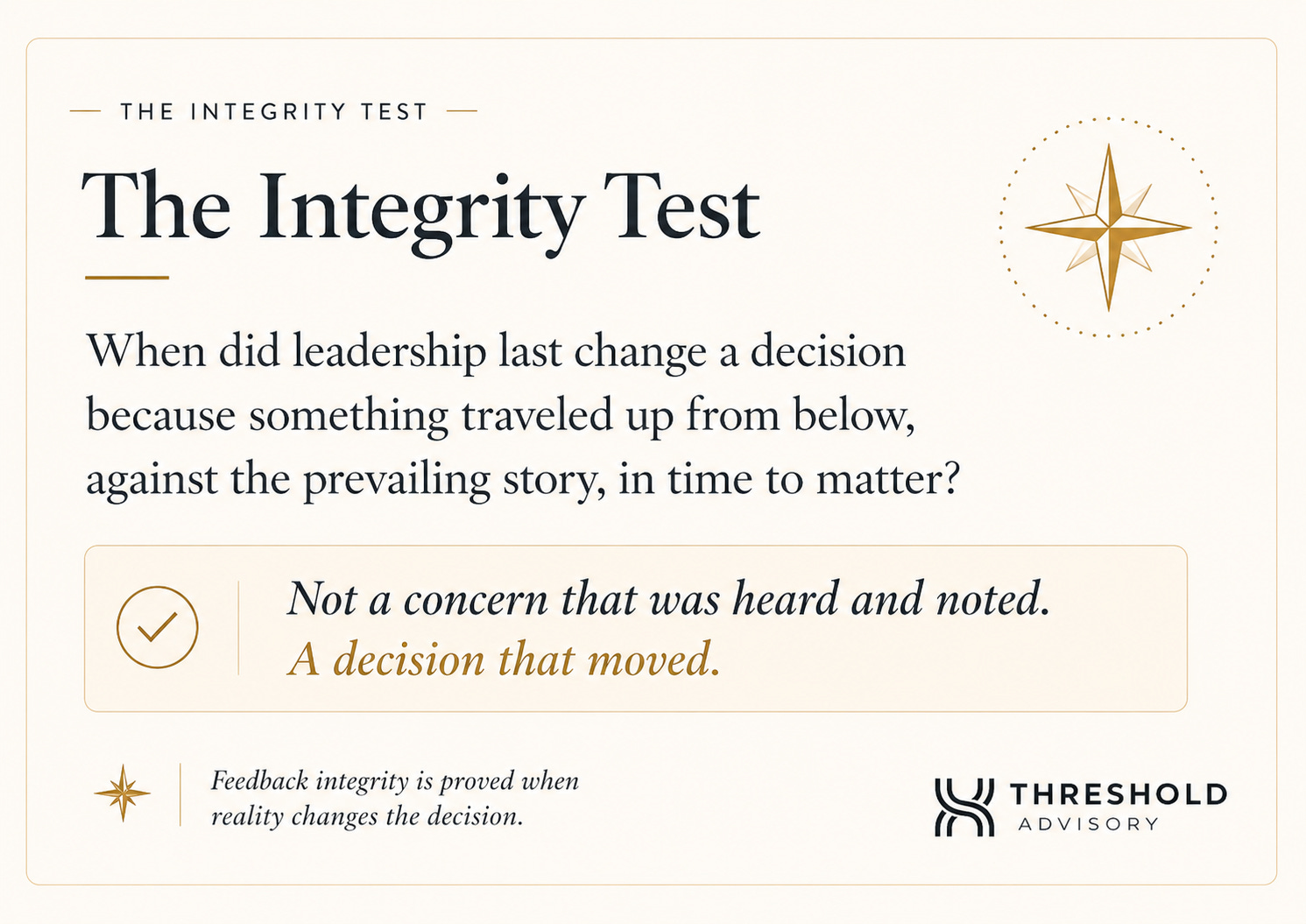
There is a simple way to check whether an organization has feedback integrity or only the feeling of it. Ask when leadership last changed a decision because of something that traveled up from below, against the prevailing story, in time to matter. Not a concern that was heard and noted. A decision that moved.
If the answer comes easily, the infrastructure is probably holding. If it takes a while to find an example, the organization may have a great deal of safety and very little integrity. It is comfortable and uninformed at the same time. That combination is dangerous precisely because it does not feel dangerous. The room is calm. People are willing to speak. The signal still does not reach the decision.
Feedback integrity is not proved because someone said the difficult thing. It is proved because the system preserved it long enough for reality to change the decision. An organization that cannot do that is not merely bad at feedback. It is governing from a manufactured picture of itself.